The 2026 Lettuce Recall Was Scoped by a Date Printed in Ink
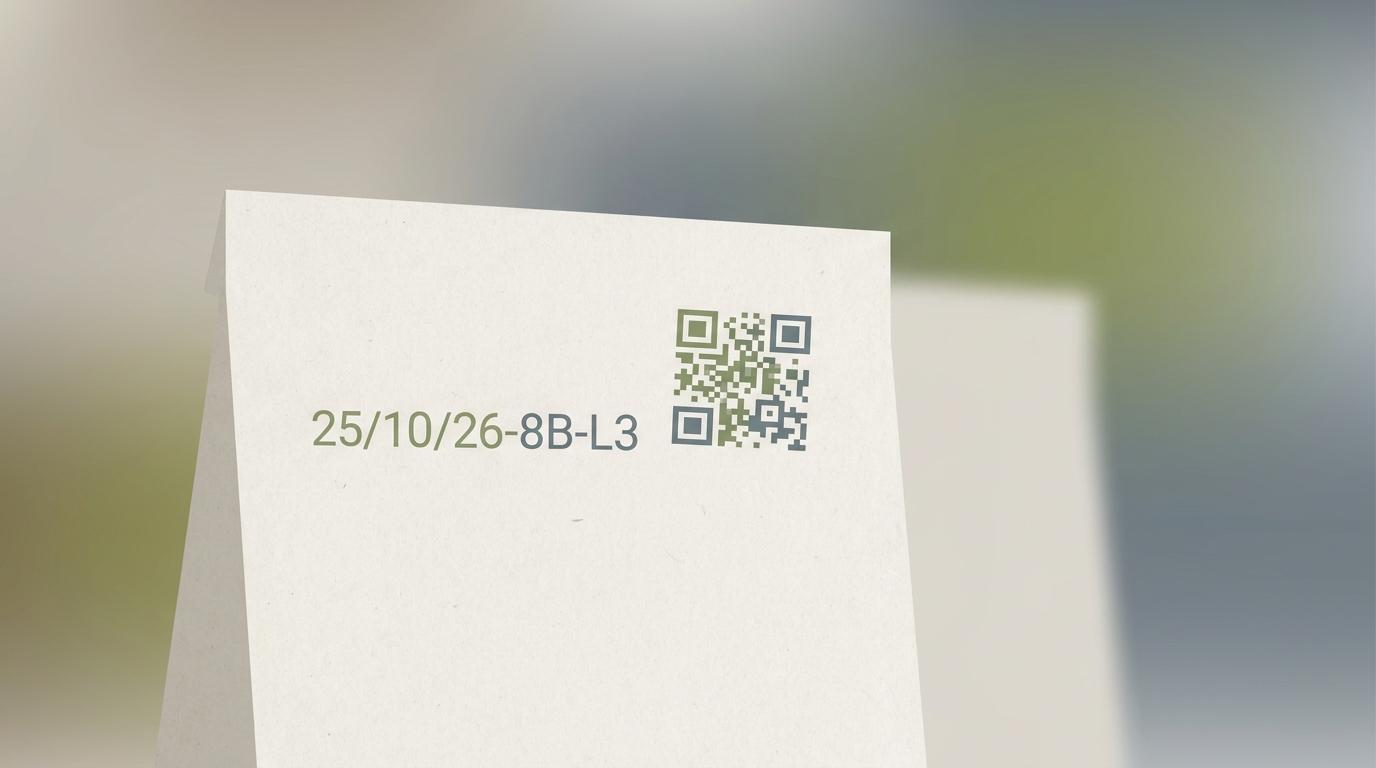
The information needed to scope this recall to exact lots was already printed on the packaging. It was just ink.
In July 2026, a cyclospora outbreak linked to shredded iceberg lettuce became the largest cyclosporiasis outbreak on record in the United States. As of the FDA’s August 20 update, 10,930 people across 17 states had been counted as part of the outbreak, with 454 hospitalizations. Two deaths have been reported in Michigan; FDA says both individuals had significant underlying health conditions that may have been adversely impacted by cyclosporiasis and dehydration, and that both had illness onset dates prior to the July 17 recall.
When the recall came on July 17, it covered every head of iceberg lettuce one supplier had sourced from an entire growing region of central Mexico. Shoppers were told to identify affected bags by matching a brand, a package size and a printed Best if Used By date range against a press release.
None of that happened because anyone was careless with data. It happened because the data that existed could not be read by a machine.
This is a traceability infrastructure story, not a food safety failure story. We want to be precise about that, because the distinction is the entire point.
What the recall actually asked shoppers to do
Look closely at how the recall told you whether your bag was affected.
The retail notice identified Marketside-brand product sold at Walmart: bagged iceberg salad in 12 oz and 24 oz, bagged shredded iceberg lettuce in 8 oz and 16 oz, carrying Best if Used By dates from 7/18/2026 through 8/3/2026. Foodservice customers got a separate document of lot codes and use-by dates.
That Best if Used By date was printed on every single bag. The lot code that would have settled the question completely was printed on the case. All of the information needed to scope this recall to exact lots already existed, on the packaging, at the moment of sale.
It was just ink.
A GS1 Digital Link QR code carrying the lot number and the best before date turns that same ink into something a phone or a register can act on in milliseconds. The data does not need to be invented, gathered or standardized into existence. It is already there. It simply has no machine-readable layer to live on, so the only reader in the loop is a human squinting at a bag and comparing it to a news story.
Detection: weeks of interviews
The signal that started this investigation was epidemiological, and it was slow by nature.
Michigan analyzed food exposure histories from 190 interviewed cases who reported eating at the same restaurant chain, and found that 90% of them reported eating iceberg lettuce. That ingredient-level analysis is what pointed investigators at a specific commodity and, from there, a specific supplier.
The elapsed time depends on which case definition you use, and it is worth being careful here. Under the initial definition, which scoped the outbreak to people reporting exposure at one restaurant chain, illness onsets ran from May 13 and the recall came on July 17 - roughly nine weeks. CDC later broadened the definition on August 5 to include people who bought the recalled product at retail, and onsets under the current definition begin June 22 and run through August 11. Either way, the shape is the same: people got sick, and it took weeks of interviews and record requests before anyone could name the product.
A scan layer would not replace any of that. Cyclospora has a long incubation period, laboratory confirmation takes time, and CDC’s case definitions exist for good reasons. What a scan layer adds is a second, faster signal running in parallel: consumers scanning the code on a bag to report an illness against a specific lot, and lot-level clustering surfacing an anomaly while the epidemiological work proceeds. It supplements confirmation. It does not substitute for it, and anyone selling it as a substitute is selling something they should not.
Traceback: record requests instead of queries
Once investigators had a commodity, the next question was which lots went where, and when.
Answering that today means requesting records from distributors and processors, reconciling formats, and reconstructing a chain by hand. The recalled product had been distributed between June 29 and July 16 to 31 confirmed states, with FDA noting it may have reached nine more, through Walmart, multiple restaurant chains and major foodservice distributors including Sysco. That is a lot of paper.
With GTIN plus lot encoded in a Digital Link on every case and consumer unit, and EPCIS events captured at pack, ship and receive, “which lots did these locations receive during the exposure window” stops being a records project and becomes a query. Hours, not weeks.
This is not a speculative capability. It is close to precisely what FSMA 204 already asks for on this product category, which we will come back to.
Scoping: when you cannot prove which units, every unit is affected
Here is the part that should make every brand uncomfortable, because it is the part that has nothing to do with how carefully anyone was operating.
The supplier, Taylor Farms, initiated the recall voluntarily. It has said publicly that the FDA’s traceback points to a specific independent farm representing less than 1% of the US iceberg lettuce supply, and that it nonetheless removed all iceberg lettuce from the region indefinitely. The day after the recall, it suspended production of all products, not just lettuce, at the facility.
Take that claim at face value for a moment. It is the strongest argument for lot-level machine-readable identity there is. If the implicated supply really was one farm’s worth, then with lot-scoped identity the recall could have been that farm’s lots and nothing else. Without it, the only defensible scope was everything from the region, followed by shutting the plant.
The company also says it invests more than $200 million annually in independently audited food safety protocols, and that roughly 2,000 of its own samples taken since May returned no positive results. Set aside whether those numbers settle anything about causation, because they do not, and notice what they do settle: an operator spending at that level still could not scope its own recall any more precisely than “everything from the region.” Not because it lacked diligence. Because the scoping layer does not exist in the industry.
When you cannot prove which units are affected, every unit is affected. That is not a company-specific failure. It is the default behavior of a supply chain whose finest-grained machine-readable identifier is a UPC that says “iceberg lettuce, 8 oz” and nothing more.
It is also worth being precise about what rests on what. The case against the product is epidemiological. A positive from a border surveillance sample announced in mid-July was withdrawn days later, with FDA concluding the finding “does not represent true amplification and should be considered a false positive,” and FDA stated that as of July 19 there were no confirmed positive sample results for cyclospora in product testing. FDA was explicit that the retraction did not change the basis for its investigation or what it called the overwhelming epidemiological data supporting the voluntary recall, and it has since begun onsite inspection and sampling at iceberg lettuce growers in Mexico. CDC now states that public health officials have identified the supplier’s lettuce as the source of the outbreak. The company disputes causation and has commissioned an independent review. Litigation is active. Those are the positions of the parties and the agencies; we are not in a position to resolve between them, and this post does not try to.
Consumer identification: a date range and a press release
For the person standing in their kitchen holding a bag, the recall reduced to a matching exercise: check the brand, check the package size, check whether the printed date falls between July 18 and August 3, and if you are unsure, throw it out.
“If you are unsure, throw it out” is the correct public health advice given the available tools. It is also an admission that the identification mechanism does not work reliably. Bags get opened. Labels get torn. Contents get decanted into other containers. And the recalled foodservice product carried different date ranges from the retail bags, so even the date rule was not uniform across the recall.
The alternative is unglamorous and completely achievable: scan the code on the bag, and the resolver returns the recall status for that exact lot. Affected, and here is what to do. Not affected, and here is the normal product page. Re-scan after the recall is resolved and see the all-clear. No press release matching, no date arithmetic, no guessing.
That flow is not aspirational for us - it is the recall behavior we already build and test, where a resolver rule scoped to a lot changes what a scan returns without touching anything else in the catalog.
Retail enforcement: destroy everything defensible
Downstream, the same missing layer produced the same blunt outcome. Sysco removed all of the supplier’s Mexican-processed iceberg from distribution and instructed customers to destroy it. Walmart pulled the Marketside SKUs. Restaurant chains dropped the product outright.
Every one of those decisions was rational. If you cannot tell which cases in your warehouse are implicated, destroying all of them is the only defensible choice, and the unaffected product goes in the same dumpster as the rest.
With recall status attached to lots in a resolver, receiving and lane scans can flag or block the specific lots on contact while unaffected lots keep moving. Distributors destroy what is actually implicated instead of everything that might be. The waste, and it is enormous, is a direct cost of the missing identifier.
The rule that was supposed to already be in force
Iceberg lettuce sits on the FDA’s Food Traceability List, which covers fresh leafy greens including fresh-cut product. FSMA 204 requires traceability lot codes, key data elements captured at critical tracking events, and electronic records producible to FDA within 24 hours - which is to say, close to the capability described above.
The original compliance date was January 20, 2026. FDA proposed a 30-month extension in March 2025, published it in August 2025, and Congress made the delay binding in November 2025. The deadline now sits at July 20, 2028.
This outbreak began roughly six months into the world where the rule was originally supposed to already apply, for exactly this product category. The rule’s premise did not wait for its enforcement date to be proven right.
What belongs on a bag of lettuce
Fresh-cut produce cannot be economically serialized. You are not putting a unique serial number on every bag of shredded iceberg, and you do not need to. The unit of recall here is the lot, so the unit of identity should be the lot.
For this category that means three things in the Digital Link: the GTIN (AI 01), the batch or lot number (AI 10), and the best before date (AI 15). That is it. AI 15 is the same value that already prints on the bag as “Best if Used By” - the same date semantics we render under California’s AB 660 date-label rules - and AI 10 is the field that makes a surgical recall possible at all.
Encoding those three fields is a small change to a print pipeline. It is not a small change to what happens on the worst day. We have written up the practical version - which AIs to encode for lot-managed goods and how recall status resolves per lot - as a lot-scoped recalls guide in the docs.
The carrier is coming either way
Sunrise 2027 puts a 2D barcode on the package. That is happening regardless of what any individual brand decides, because retailers are building the lane infrastructure to accept it.
What is still genuinely undecided is what brands choose to encode on it. A Digital Link carrying only a GTIN is a prettier UPC: it reaches a product page and can tell you nothing about which bag you are holding. The same carrier with a lot and a best before date is a recall that can be scoped with a scalpel.
Everything in the alternate timeline above exists today. Lot-scoped Digital Link QR codes, a resolver that returns recall status on scan, and lot-level signals from consumers who scanned a product and then got sick.
The data was already on the bag. The next recall gets to decide whether a machine can read it.
The same gap showed up on a much smaller recall this August: a yogurt notice that asked members to compare a printed code against a list of 24 best before dates.
All figures in this post are attributed to FDA, CDC, state health authorities or company statements and are current as of August 21, 2026. Outbreak counts have been revised repeatedly and will continue to change; check the linked primary sources for current numbers.