Tesco, Walmart, and 60+ Retailers Are Already Moving to QR Codes: Is Your Brand Ready?
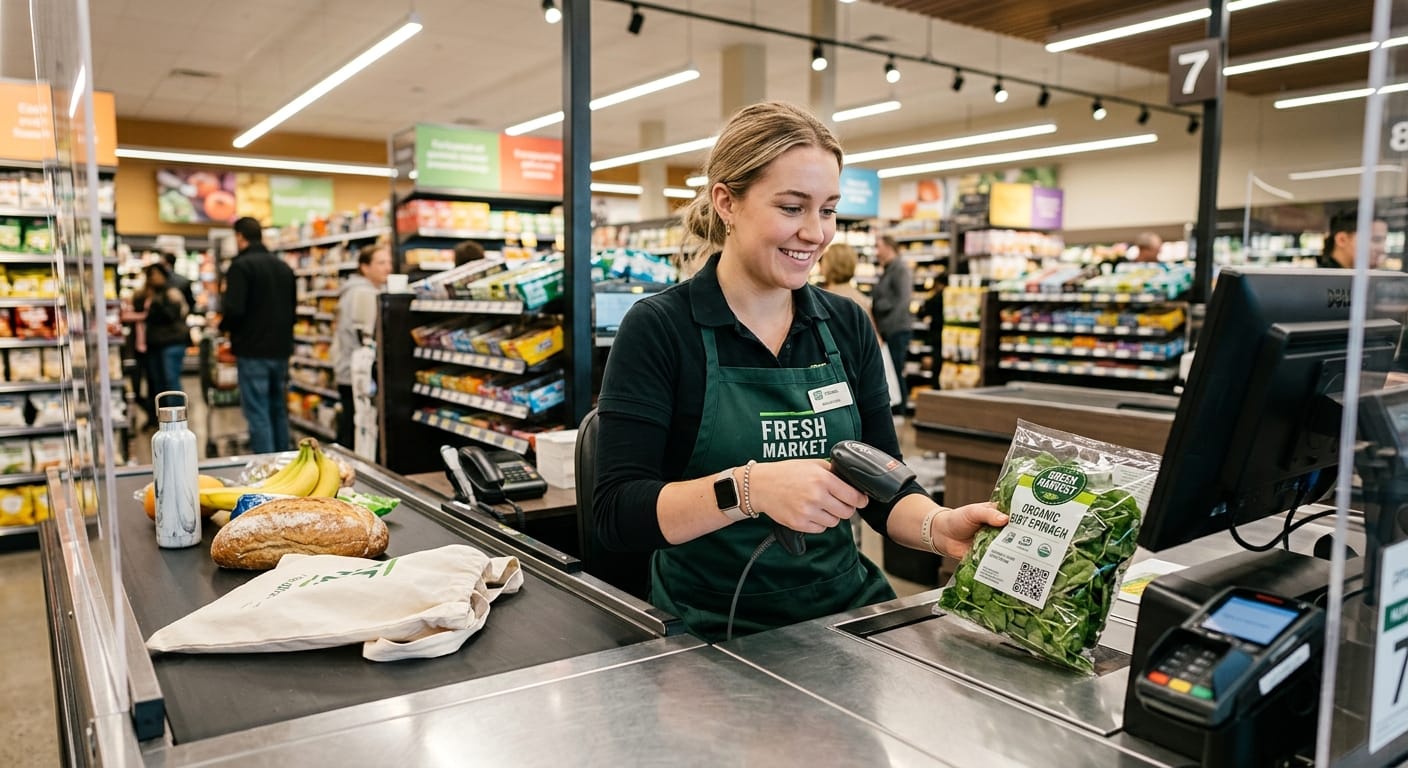
In early 2025, Tesco launched its second trial of QR codes at the checkout. Twelve own-brand fresh produce and meat products across roughly 20% of UK stores now carry 2D barcodes - and on some of those products, the traditional UPC barcode has already been removed entirely.
Not supplemented. Not placed alongside. Removed.
That is not a pilot program in the conventional sense. That is a retailer with over 4,000 stores making an operational decision about how products get scanned and sold. And Tesco is far from alone.
It’s Not Just Tesco
More than 60 retailers across 48 countries - representing approximately 88% of global GDP - have committed to accepting 2D barcodes at the point of sale by the end of 2027. This is the GS1 Sunrise 2027 initiative and it is moving from roadmap to reality faster than most brands realize.
Walmart and Kroger are testing dedicated 2D checkout lanes in US stores, verifying that their scanning infrastructure can handle QR codes alongside traditional barcodes during the transition period.
Target has communicated to suppliers that it expects 2D barcode readiness by the end of 2027 - a deadline that, for products with long packaging lead times, is already uncomfortably close.
Dillard’s may have offered the most vivid illustration of why the industry wants this change. CTO Chuck Lasley described scanning a single hang tag that contained six separate data carriers - different barcodes for different purposes, layered on top of one another. His conclusion was understated: “I think we can probably reduce that.”
Wegmans SVP and CIO Dave DeLaus has been vocal about the operational benefits, particularly around fresh food traceability. Publix SVP Dave Bornmann has similarly pointed to supply chain visibility as a driving factor for adoption.
And then there is Woolworths Australia, which reported reducing food waste by up to 40% after implementing 2D barcodes on fresh products. A single QR code carrying batch and expiration data enabled dynamic markdowns, smarter stock rotation and automated pull-from-shelf decisions - none of which are possible with a static UPC.
The retailer list extends well beyond these names. Carrefour in France, major chains across Asia-Pacific and Latin America - the geographic breadth of commitment is as notable as the depth.
As Renaud de Barbuat, President and CEO of GS1, put it plainly: “By end of 2027, all retailers in the world will be able to read those next-generation barcodes.”
The Brands Are Already There
Retailers are upgrading their scanners, but the brands printing the packaging are not waiting around either.
Procter & Gamble CEO Jon Moeller wrote directly to the Consumer Goods Forum Board identifying the 2D barcode transition as a “primary focus” for the company. When the CEO of the world’s largest consumer goods company characterizes something as a primary focus in writing to an industry board, it tends to move markets.
Coca-Cola is already using QR codes operationally in Latin America, where refillable bottle programs require tracking individual containers through multiple fill cycles. The QR code on each bottle links to its production data, return history and quality checks - functionality that a 12-digit UPC could never support.
Unilever is trialling accessible QR codes designed for visually impaired consumers, connecting packaging to audio descriptions of ingredients, usage instructions and allergen warnings. The 2D barcode becomes an accessibility interface, not just a checkout mechanism.
Nestle, L’Oreal, and Puma are all at various stages of QR integration across product lines, driven by a mix of regulatory compliance, sustainability reporting and consumer engagement goals.
The pattern is consistent: the largest companies in consumer goods are not treating Sunrise 2027 as a future consideration. They are building it into current packaging cycles.
Why Now?
Three forces are converging to make this transition feel less optional than previous industry standards efforts.
Consumer expectation. A study by GS1 UK and FT Longitude found that 79% of consumers prefer products with scannable QR codes that provide additional information. That same study found that 41% of British retail executives predict a total barcode phase-out within five years. Anne Godfrey, CEO of GS1 UK, summarized the trajectory: “Very soon we will say goodbye to the old-fashioned barcode.”
Consumers have spent the past decade learning to scan QR codes for restaurant menus, event tickets and payments. Expecting the same from product packaging is not a behavioral leap - it is a behavioral extension.
Regulatory pressure. In the United States, FSMA Rule 204 requires enhanced traceability for high-risk foods, with compliance deadlines that align closely with Sunrise 2027. Batch-level and lot-level data encoded in 2D barcodes is one of the most practical paths to meeting those requirements.
In the European Union, the Digital Product Passport (DPP) regulation will require detailed product lifecycle information to be accessible via a data carrier on the product itself. QR codes linked to GS1 Digital Link URIs are the leading technical approach for compliance.
These are not aspirational frameworks. They are regulations with enforcement dates.
Operational ROI. Woolworths’ 40% reduction in food waste is the headline figure, but the operational case extends further. Dynamic pricing based on expiration dates, automated recall identification at the shelf level, supply chain visibility from factory to checkout - these capabilities translate directly to margin improvement and risk reduction.
When regulation, consumer preference and operational savings all point in the same direction, adoption tends to accelerate past the point where waiting feels like a strategy.
The Missing Infrastructure
Here is the part that gets less attention in the industry press: a QR code on a package is not useful by itself.
A traditional barcode maps to a number. A scanner reads the number and looks it up in the retailer’s internal database. The barcode does not contain or link to any information - it is an identifier, nothing more.
A GS1 Digital Link QR code is fundamentally different. It encodes a web URI - a URL that resolves to product information. When a consumer, retailer, regulator or supply chain partner scans that code, they expect it to go somewhere. They expect it to return structured data: product details, batch information, recall notices, sustainability documentation, nutritional data.
That “somewhere” is a resolver. It is the infrastructure that receives the request and returns the right information to the right audience. A consumer scanning with their phone gets a product page. A retailer’s point-of-sale system gets a GTIN. A regulatory auditor gets traceability records.
Without a resolver, a GS1 Digital Link QR code is a URL that leads to a 404 page. The QR code on the package is only as useful as the system behind it.
This is the infrastructure gap that most brands have not yet addressed. Retailers are upgrading scanners. Packaging teams are learning to print QR codes. But the resolver - the system that makes the QR code actually work - is often an afterthought or assumed to be someone else’s problem.
How Closient Fits
Closient is a commercial-grade GS1 Digital Link resolver built specifically for this transition.
Resolver infrastructure. Every product gets a standards-compliant GS1 Digital Link URI that works at the point of sale, in the supply chain and in the consumer’s hand. One QR code, multiple audiences, correct responses for each.
Product pages. When a consumer scans your QR code, they land on a branded product page with the information they expect - ingredients, sourcing, certifications, usage instructions. No app download required.
Recall system. When a recall is issued, the same QR codes that were already printed and distributed become the notification channel. Scan a recalled product, get the recall notice. This works retroactively on every product already in the field.
Permanent QR codes. The URI encoded in your QR code does not change. The content behind it can be updated at any time without reprinting packaging. Launch with basic product information today; add sustainability data, regulatory documentation or promotional content tomorrow.
No per-scan fees. The business model is straightforward. You are paying for resolver infrastructure, not metered access to your own product data.
The brands and retailers listed in this article are not waiting for 2027 to arrive. They are building now, testing now and in some cases - like Tesco - already shipping products without traditional barcodes at all.
The resolver is the piece that makes the rest of it work. If your brand is printing QR codes without one, you are printing URLs that lead nowhere.
Ready to see how a resolver works for your products? Visit closient.com or reach out to our team directly.