The Recall That Found Every Affected Customer
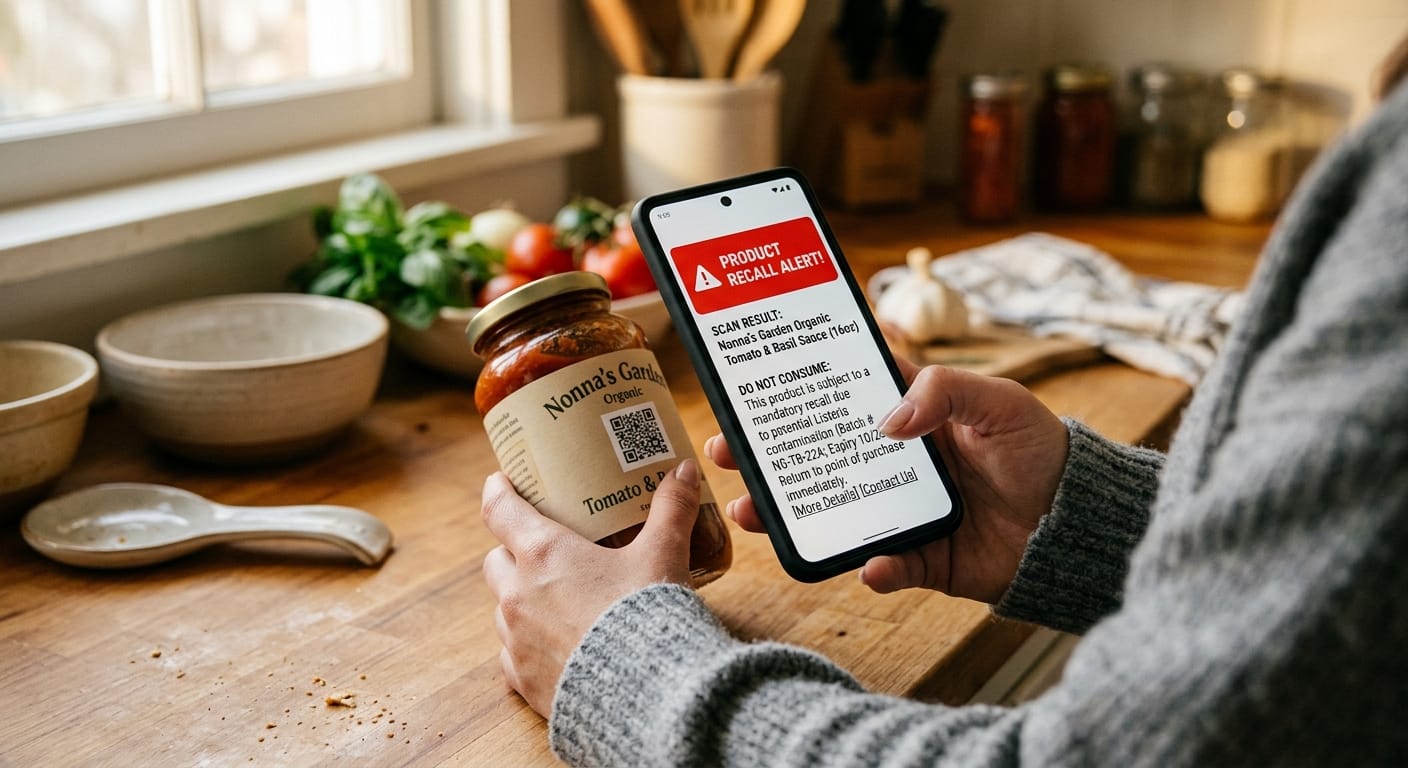
What if a product recall could reach every affected customer and leave everyone else alone? Here’s how lot-level QR codes and a resolver make that possible.
A Recall the Old Way
It starts with a phone call nobody wants to receive.
A mid-size food brand - let’s call them Greenfield Provisions - learns that batch 4521 of their organic peanut butter may be contaminated with salmonella. The batch represents about 3,200 jars, shipped to roughly 140 retail locations across three states over the past six weeks.
What happens next is a well-rehearsed disaster.
The quality team drafts a press release. Legal reviews it. Marketing winces. The FDA posts a notice on its recall page - one of hundreds published each month. The brand contacts retail partners, who receive the recall notification alongside dozens of others that week. Store managers are told to pull the product. But which product, exactly?
The UPC barcode on every jar of Greenfield’s organic peanut butter is identical. Batch 4521 looks the same as batch 4519 and batch 4523 on the shelf. There is no way to distinguish them at the point of sale. So retailers do the only rational thing: they pull everything. Every jar. Every batch. Every store.
The unaffected inventory - representing tens of thousands of dollars in product that is perfectly safe - goes into a dumpster.
Meanwhile, the consumers who actually bought jars from batch 4521 have almost no way of finding out. The FDA recall page exists, but almost nobody checks it proactively. The press release might get picked up by a local news outlet or it might not. The brand has no way to contact the people who bought the product because they have no idea who those people are. The jar was scanned at checkout with a UPC that identifies the product but says nothing about the batch, the production date or the consumer.
Weeks later, Greenfield is still dealing with the aftermath. Retail partners are cautious about restocking. The legal team is fielding inquiries. The brand’s social media is a mix of concerned parents and opportunistic outrage. The total cost - destroyed product, lost sales, legal exposure, brand rehabilitation - runs well into six figures for a contamination event that affected 3,200 jars.
This is not a hypothetical. Some version of this story plays out hundreds of times a year across the food industry alone. The USDA’s Food Safety and Inspection Service and the FDA together issue more than 400 recalls annually. The mechanics are almost always the same: broad, blunt, expensive and slow to reach the people who actually need to know.
The Same Recall With 2D Barcodes and a Resolver
Now rewind. Same brand, same contamination, same batch 4521. But this time, every jar of Greenfield’s peanut butter carries a GS1 Digital Link encoded in a 2D barcode - a QR code that contains not just the product identifier (the GTIN) but also the lot number and, optionally, the production date and expiration.
When Greenfield’s quality team confirms the contamination, they log into their resolver dashboard and update a single rule: for lot 4521, override the default product page destination with a recall alert. The change takes effect immediately.
From that moment forward, any consumer who scans a jar from batch 4521 sees a clear, branded recall notice with instructions for return or disposal. Consumers who scan jars from any other batch see the normal product page - ingredients, sourcing story, recipes - because their product is fine.
Retailers receive the same lot-level information through their systems. Instead of pulling every jar, store staff can check lot numbers and remove only the affected batch. The safe product stays on the shelf, continues selling and continues building the brand.
But it goes further. The resolver’s scan analytics show which consumers have interacted with jars from batch 4521 - not their personal identity, but the fact that a scan occurred, when and where. If the brand has opted consumers into notifications (through a loyalty program, a registration flow or even just a prior scan interaction), it can send targeted alerts to the people most likely to have the affected product in their pantry.
The recall goes from a broadcast hoping to reach the right people to a narrowcast that finds them.
The financial difference is significant. Product destruction is limited to the affected batch. Retail relationships are preserved because partners can see the brand is handling the situation with precision. Consumer trust actually increases because the people who scan the product see that the brand is being transparent and proactive. Legal exposure decreases because the brand can demonstrate a documented, traceable response.
Why This Only Works With the Full Stack
It is tempting to think that putting a QR code on a package solves this problem. It does not - at least not by itself.
A QR code that points to a static URL (say, greenfield.com/peanut-butter) cannot differentiate between lots. Every jar goes to the same page. You are back to the same problem: no way to show a recall notice to affected consumers without showing it to everyone.
A GS1 Digital Link encodes the lot number into the URI structure itself. The URL for batch 4521 is different from the URL for batch 4523. But that only matters if there is a resolver on the other end that knows what to do with the lot information - a system that can inspect the lot number in the request, check it against a set of rules and route the consumer to the appropriate destination.
And even a resolver with per-lot routing only solves half the problem if the brand has to manually monitor regulatory feeds and figure out which of their products are affected. Recall notices from the FDA, FSIS, CPSC and Health Canada arrive in different formats, on different schedules, with inconsistent product identification. Matching a regulatory notice to a specific GTIN and lot requires both deterministic matching (exact UPC or GTIN lookups) and fuzzy matching (brand name variations, product description parsing, manufacturer identification).
The full stack - 2D barcode with lot-level data, resolver with per-lot routing and automated recall detection that ingests and matches regulatory data - is what turns a recall from a crisis into a controlled response.
The Regulatory Context
This is not just a nice-to-have. Regulation is moving in this direction on multiple fronts.
In the United States, the FDA’s FSMA Rule 204 (Food Traceability Rule), which took effect in January 2026, requires lot-level traceability for foods on the Food Traceability List. Companies must maintain Key Data Elements including lot codes and be able to provide traceability information to the FDA within 24 hours of a request. The rule does not mandate 2D barcodes specifically, but the data requirements align precisely with what GS1 Digital Link encodes.
GS1 US’s Sunrise 2027 initiative sets the deadline for retailers to be able to accept 2D barcodes at point of sale. This is the infrastructure shift that makes lot-level data available throughout the supply chain - not just on paper records, but encoded on the product itself and readable at every touchpoint from warehouse to checkout to the consumer’s kitchen.
In the European Union, the Digital Product Passport (DPP) regulation requires data carriers on textiles and footwear, batteries and electronics starting in 2027, with additional product categories following. The DPP must be accessible via a scannable data carrier on the product - again, aligning with the GS1 Digital Link approach.
These regulations are creating the conditions where lot-level data will be encoded on products as a matter of course. The question is whether brands will have the resolver infrastructure to act on that data when it matters most.
How Closient’s Recall Detection Works
Closient operates a commercial-grade GS1 Digital Link Resolver with recall detection built into the core platform, not bolted on as an afterthought.
The system continuously ingests recall data from four regulatory sources: the FDA’s enforcement reports and recall notices, the USDA’s Food Safety and Inspection Service recall archives, the Consumer Product Safety Commission’s recall database and Health Canada’s recall and safety alert feed. These feeds are monitored automatically, with new notices processed as they are published.
Matching works in two layers. Deterministic matching handles the straightforward cases: when a recall notice includes a UPC, GTIN or other standardized product identifier, the system matches it directly against products registered in the resolver. Fuzzy matching handles everything else - and in practice, “everything else” is a lot. Recall notices frequently identify products by brand name, product description, package size and manufacturer, with inconsistent formatting. The matching engine normalizes these fields and scores potential matches against the product catalog.
Potential matches enter a brand review queue where the product owner can confirm or dismiss them. For high-severity recalls - Class I recalls involving a reasonable probability that exposure will cause serious adverse health consequences - the system can auto-override the resolver destination immediately, notifying the brand simultaneously.
When a recall is confirmed, the resolver updates instantly. Consumers scanning affected lots see the recall notice. Consumers scanning unaffected lots see the normal product experience. Scan analytics provide visibility into consumer interactions with recalled products, supporting both targeted notification and regulatory documentation requirements.
One principle governs the entire system: recalls are never monetized. Closient does not charge brands for recall detection, recall routing or recall notifications. Product safety is infrastructure, not a revenue line. It is included in the resolver service because it is inseparable from the resolver’s purpose.
A Controlled Response, Not a Crisis
A recall is the worst day in a brand’s life. No technology eliminates that reality. Contamination happens. Defects happen. The question is not whether a brand will ever face a recall - statistically, many will - but whether the response will be precise or blunt, fast or slow, documented or improvised.
The infrastructure to make recalls precise exists today. GS1 Digital Link gives every unit a unique, scannable identity that includes lot-level data. A resolver turns that identity into a dynamic destination that can change in real time. Automated recall detection connects regulatory reality to the resolver without waiting for someone to notice a press release.
None of this requires futuristic technology. It requires adopting standards that are already published, meeting regulations that are already in effect or taking effect within the next year and connecting systems that already exist.
The brands that build this infrastructure will not do so because of recalls. They will do it for consumer engagement, for supply chain visibility, for regulatory compliance, for the dozen other reasons that lot-level digital identity makes sense. But when the worst day comes, they will be glad the infrastructure was already in place.
A recall does not have to be a broadcast into the void, hoping the right people happen to hear it. It can be a direct, documented, controlled response that reaches every affected customer and leaves everyone else alone.
That is what is now possible.